Commercial Checkride in 3 Acts
ACT I
Summer in the southeastern U.S. means afternoon thunderstorms most days, so the checkride wasn’t looking likely. I thought I might be able to drive to Huntsville Executive Airport and knock out at least the oral if the weather had been bad, but another pilot told me the examiner isn’t allowed to start the oral portion of the practical test without a reasonable expectation of being able to complete the checkride. I took his word on it, but as the day got closer, the forecast hinted at a possible window.
My instructor John had targeted finishing the ride in May, but I wound up with a proposal due at the beginning of July. Getting it written, reviewed, and rewritten didn’t leave a lot of time or clear headspace for flying. The appointment with Max Gurgew was for a couple of Saturdays ago at 1 o’clock. Sunday would be the start of a trip with my wife and kids for a week at the beach. My medical also expires at the end of July.
The time crunch was on.
Waking up on checkride day, I opened ForeFlight to check the TAF and MOS. The approaching weather had slowed down with the storms forecast to begin after 5. Later that morning, John called for a final pat on the back and to say Max may expedite the flight portion to complete the requirements in the time that the weather allowed, so be ready for quick transitions.
Max’s website has helpful detailed information about what he expects an applicant to bring. I probably went over that checklist and the checklist in the ACS at least three times. The night before, I also adapted the private-pilot aeronautical experience spreadsheet from his website to the 61.123 requirements. Sure that I had everything, I loaded my gear and headed to pick up the airplane and fly to MDQ.
One last chance to practice the 180° power-off accuracy landing, and I put it right on the thousand-foot marks. Good deal, nothing to worry about.
Max and I began with pleasantries. I mentioned that we had a non-flying acquaintance in common. A guy who was a PM at one of my company’s prime contractors was a former employee of Max’s. He asked what I did to fund my aviation habit, and then he explained how the checkride would go. We started by qualifying the applicant. I handed him the summary sheet that I’d prepared. “Oh, you have a high-altitude endorsement,” he observed. That same flight accounts for the extensive 2.3 hours of multi time in my logbook. An MEI friend invited me along for a trip from MSL to JKA in a Cheyenne III, 53 minutes on the way down — but $1,200 of fuel for the owner. Time really is money.
That done, we moved on to the airplane, a Cessna 152, which got a chuckle out of Max. We reviewed the logbook entries for the most recent 100-hour inspections, annuals, and AD signoffs that the A&P/IA had helpfully tabbed when he turned over the logbooks.
Having established eligibility, he collected his fee and started the questions. We went over commercial pilot privileges, flying someone else’s airplane for hire, 119.1(e) exemptions, VFR minimums, sectional chart markings, Class E airspace, types of NOTAMs, weight limitations including ramp weight and zero-fuel weight, true versus indicated versus calibrated airspeeds, effects of density altitude, effects of forward and aft center of gravity, temperature and humidity ranges for greatest risk of carburetor icing, supplemental oxygen requirements, communication and equipment requirements for entering airspace along the way, and special-use airspace. John was adamant about using the 152 because of its simple systems. We didn’t have a ton to discuss on the systems portion. We discussed 91.213, Kinds of Equipment Lists, and Minimum Equipment Lists along with a couple of real-world scenario questions. He asked about the fuel system, alternator power output, and spin recovery. I recited the usual PARE, but in the 152, the order in the POH is slightly different. He asked other scenario-based questions related to my planned cross country, for which I learned I was going to pick up my “crazy uncle” at RNC and then fly him to PDK. Although crazy, this uncle was also generous and wanted to offer $500 for all my trouble. I replied that unless the landing fees at PDK were unusually high that day, I wouldn’t be able to accept.
By then it was getting close to 3 o’clock. We checked the weather, and the thunderstorms had hurried up to be nearly on top of us. Max suggested that we preflight just in case but that of course the decision of whether to depart was mine as PIC. With the walkaround complete, the skies were looking worse. The weather picture and forecasts on ForeFlight showed it would be unfavorable for several hours. Bummed because I was hoping to have it done before family vacation, I said we wouldn’t be flying, so we went inside for Max to write the letter of discontinuance. He handed it to me along with my original Knowledge Test Report that I’d already been holding for a year. We scheduled for the Tuesday afternoon after my family was scheduled to return from the beach, shook hands, and went our separate ways.
Act II
The beach was great. We had a laid back, relaxing stay. The seafood was delicious. My parents made the trip over one afternoon, and my brother came over on a different day. My son and I played a couple of rounds of golf. Max sent a text message asking about doing the flight portion on the following Saturday. We had to be back on Friday anyway for my daughter to dogsit for a neighbor, so I accepted.
Saturday arrives, and I go through the routine again of double- and triple-checking all my gear and paperwork. A friend flew his CFI initial checkride recently but forgot to bring his medical somehow. His wife had to drive it out to MDQ for him. Checkride day is stressful enough, and there’s no need wasting brownie points in an avoidable situation.
At the flying club, I checked out and preflighted the airplane. The fuel was low, so I pulled it to the pump and also gave the windscreen a good cleaning. A 172 departed just before me, and while I was waiting on them to finish their runup, another 172 entered the pattern. We have just one taxiway that connects the club ramp to the runway. Number one departed, the other 172 landed, taxied back, and left room for me to cross the runway and runup on a taxiway on the east side. Again I arrive at MDQ and again put my power-off 180° right on the thousand-foot marks. That maneuver had been my biggest worry and took me longest to get right. Good, I thought, a week at the beach hadn’t made me rusty.
Arriving inside Executive Flight Center, Max wasn’t yet back from the morning ride. After a bit, a company airplane taxied to the ramp and shutdown. The pilot Zach was from the same Part 61 school and taking his private ride. Max walked around the ramp to the north to his office. I got to shake the new pilot’s hand to congratulate Zach on passing. Good, I thought, he’s in a passing mood.
In his office, we reviewed the weather, talked about weight and balance, and positive exchange of flight controls. He emphasized that he would twist the yoke left and right to reinforce the verbal exchange. We then headed to the ramp for preflight during which we discussed Cessna’s split flaps, differential ailerons, Frise ailerons, the location of the flap motor, oil and fuel quantity, P-factor, torque, adverse yaw, documents required to be on board, and in particular how often registration certificates expire. Max was happy with my use of the SAFETY-style passenger briefing.
I started the airplane. We both performed brake checks. I taxied to the 18 departure end and ran the pre-takeoff checklist. Max wanted to see a soft-field takeoff, so I briefed and performed it. Up, up, and away. I made a downwind departure and then to my XC’s initial heading of 040. After we passed the nearby small town of New Market, he asked for a groundspeed estimate and then had us divert to Hazel Green (M38), for which he also wanted a heading and ETE. I told him I’d had to fly to M38 by dead reckoning on my private checkride (with a now-deceased examiner), and he said, “Then you’ll have no problem finding it.” On my private ride, I had a lot of trouble finding it because I was coming from the north, and M38 has trees to the north and south. From the east where we were, I had an easy view of the runway.
Max wanted to see a steep spiral. The wind that day was favoring runway 25. As I was about to start down, another airplane came in on approach to land runway 7. I announced switching to the other end and performed three complete turns. We climbed out, got flight following from Huntsville Approach, and headed for the northeast practice area. Weather to the south looked as though it might turn into something, so we stayed to the north of it. He asked for chandelles first and then lazy eights. We turned back to the north and did steep turns where I got a noticeable bump from my own wake at the end of the second 360.
Then he asked for stalls: landing configuration, takeoff, and accelerated. Recovered from those, and then he asked for slow flight in landing configuration. Carb heat on, power back to 1,900 RPM, white arc, and full flaps. Max went quiet for longer than I expected, and then he asked for a turn to the right. I asked for a heading, and he replied, “I’ll tell you when we get there.” This was unexpected. I see him write -250 on his plan of action. I look over at the altimeter, and it was at about 2,950 MSL. I added some power, but I was way behind the power curve. He asked whether the maneuver was complete. I knew I had messed up. Looking back, I entered slow flight at 3,200 instead of my usual 3,000. Back when I was working on my instrument rating, I would sometimes checkout like that when making radio calls.
“We will have to do that one again; would you like to continue?”
Ugh. The unsat blues, and on the easiest maneuver of them all but the one I had worked on least. I opted to continue to get as much credit as I could. He asked for an emergency descent and to pick out a location for a forced landing. I identified a field, turned to line up with both the wind and the crop rows. Down low, we performed eights on pylons. Then he asked me to take us back to MDQ for the landings.
The landings all went great. The soft-field up first was the best one I’ve flown in a long time. Full stop, taxi back, short-field takeoff, followed by short-field landing on the numbers. Here it was, the power-off 180° for keeps. I identified the thousand-foot marks as my point of intended landing. On final, I was a little high and steep but was able to dive into ground effect and drop it right on the spot. Touch and go to come back for a no-flaps landing due to a “failed” flap motor. Full stop and taxi back to the ramp. Hobbs time was 1.4.
Back in his office, I felt good about having flown almost everything well despite the added stress and disappointment but bummed at failing with what felt like a grade of 99 percent. If someone had told me before that I’d hit the power-off 180° no problem, then I would’ve said the ride was a gimme. Max tried to cheer me up saying he was pleased with how I managed the airplane, that the landings were some of the best he has seen in a while, but that I was way outside the 50-foot tolerance on slow flight. John told me later that the FAA was scrutinizing DPEs more closely and especially on commercial applicants.
Max gave me the unsat letter and my Knowledge Test Report. Keeping up with special pieces of paper is one of my least favorite obligations, and now I walked out with two instead of zero.
Act III
Max texted asking whether I could meet at 5 or earlier on Thursday. I’d already flown again with John on Sunday and got his endorsement for the retake. He was scheduled for a trip out of town that week and wanted to make sure we got it done. I filled out another 8710 and got everything confirmed.
Cyndy Hollman’s slow-flight lesson had been on repeat I don’t know how many times all week. Thursday rolls around, and the weather looked good. I knew the drill pretty well by this point. I think my flight bag needed only a single check this time around. Preflight, slow flight on the way to MDQ, but a normal landing this time on the way in. Max was still with another applicant when I got there, so I hung out in the FBO lobby and checked the weather one more time on ForeFlight.
For what I hoped was the last time, I gave Max that infernal Knowledge Test Report. He joked that I must have thought it was a boomerang the way it kept coming back. I was in the same mighty 152, so airworthiness was a piece of cake. He briefed the plan of action. We went out to the ramp, and Max walked around the airplane with me during preflight. We folded ourselves into the flying leaf. Looking back, the taxi to 18 was slow. I was determined not to fail for something stupid happening on the ground. Though I didn’t think it at the time, now I’m picturing Scotty Smalls telling himself Don’t be a goofus! Don’t be a goofus!
Normal takeoff. We fly to the east. Clearing turns. Carb heat, power back, flaps in. I may have dropped ten or twenty feet but added power and went carb heat cold. Max had me perform turns left and right. Then we went back to MDQ for a normal landing. After I completed the after-landing checklist, he reached out his hand and said “Congratulations!”
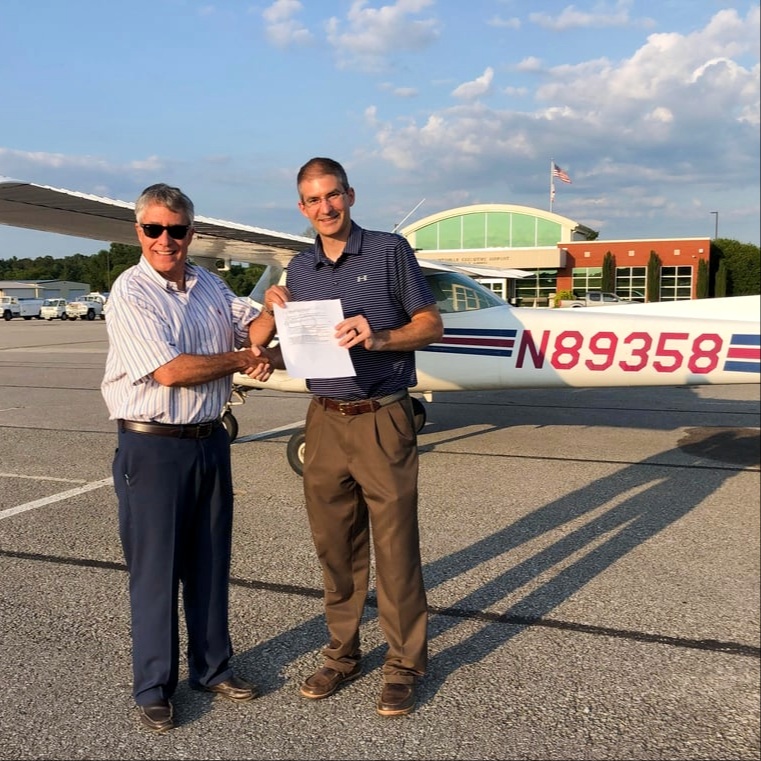
In his office, he printed my temporary certificate, we took the obligatory picture on the ramp, and Max was again complimentary on my flying. He encouraged me to continue toward CFI saying “You’re already a good bit of the way there.”
With 0.5 on the Hobbs, I think we spent more time talking than flying.
Summary
I started with no complex endorsement but already had plenty of PIC and XC time, a lot of it flying to the beach and to college football games. A while back I had a work trip to the Baltimore area that I used as my long commercial XC, adding a touch-and-go at MDQ to get three landings (MDQ-MTV-MTN) and reimbursed as an incidental trip.
To satisfy all of the FAR 61.123 requirements, I logged 52 hours that included one night flight where I went over to HSV in an Arrow and did seven laps around the patch to round out my night towered landings. Cost breakdown is below. The other category includes DPE fee, Sheppard Air, replacement foggles, and a copy of the ASA Commercial Oral Exam Guide (paid link).
| Category | Cost |
|---|---|
| Rental | $4,195.20 |
| CFI | $832.80 |
| Other | $569.00 |
| Total | $5,597.00 |
Although I wish I had performed better, I really enjoyed flying with Max and look forward to flying with him again. He is highly knowledgeable, professional, by the book, and friendly. I’d definitely recommend him as an examiner.